

In this article
- Progressive rack geometry with position-dependent pitch & pressure angle variation: geometric design based on gear fundamentals by F. Litvin
- Why standard gear design methods fail for variable-ratio racks
- Titanium alloy as a workpiece material: thermal and mechanical machining challenges
- Surface finish as a prerequisite for carbon-based coating
- Proprietary design algorithm for complete geometry generation in two weeks
- The interaction of engineering and manufacturing know-how as the decisive factor
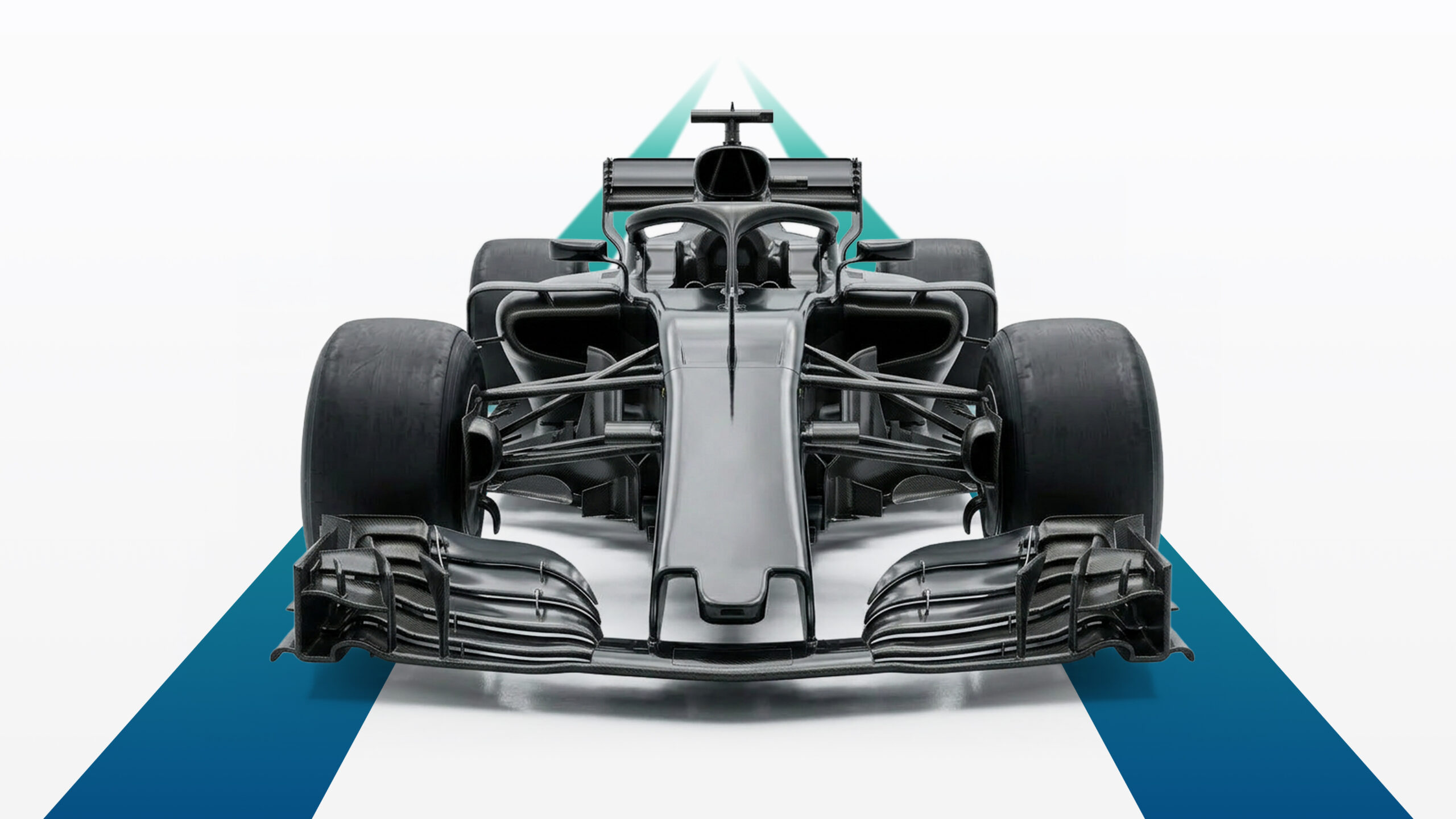
In Formula 1, the steering system does not merely affect driver feel — it determines lap times. A progressive steering rack — with a continuously varying gear ratio — combines an indirect, effort-conserving ratio in the straight-ahead position with a highly direct response in the steered range. What sounds constructively elegant places demands on design and manufacturing that lie well beyond the standard repertoire.
The Geometric Challenge: When Module and Pressure Angle Are No Longer Constant
A conventional rack operates with a constant module, constant pressure angle, and constant tooth pitch along its entire length. The kinematic condition is straightforward: the involute profile of the pinion meshes under identical geometric conditions at every point along the rack.
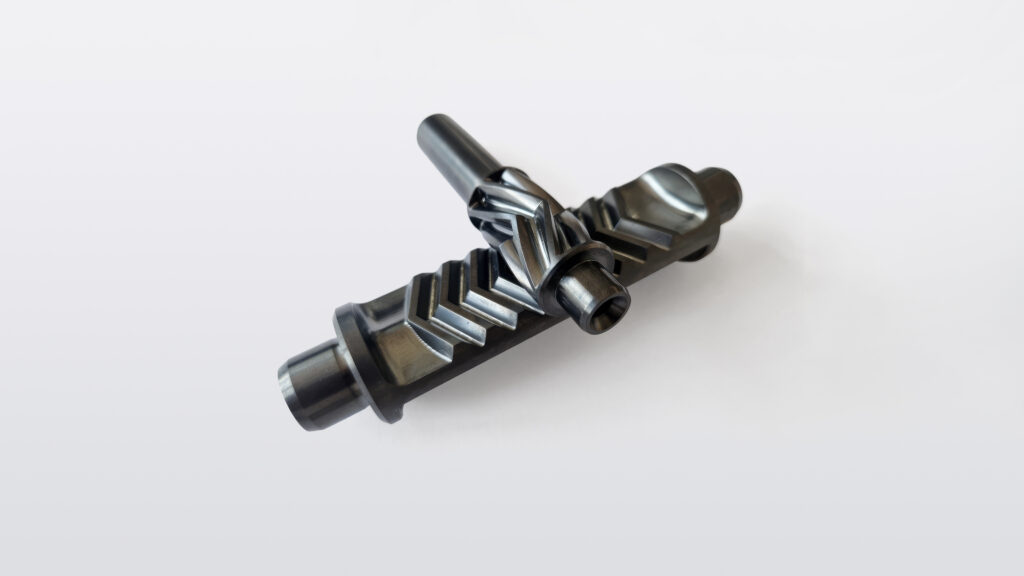
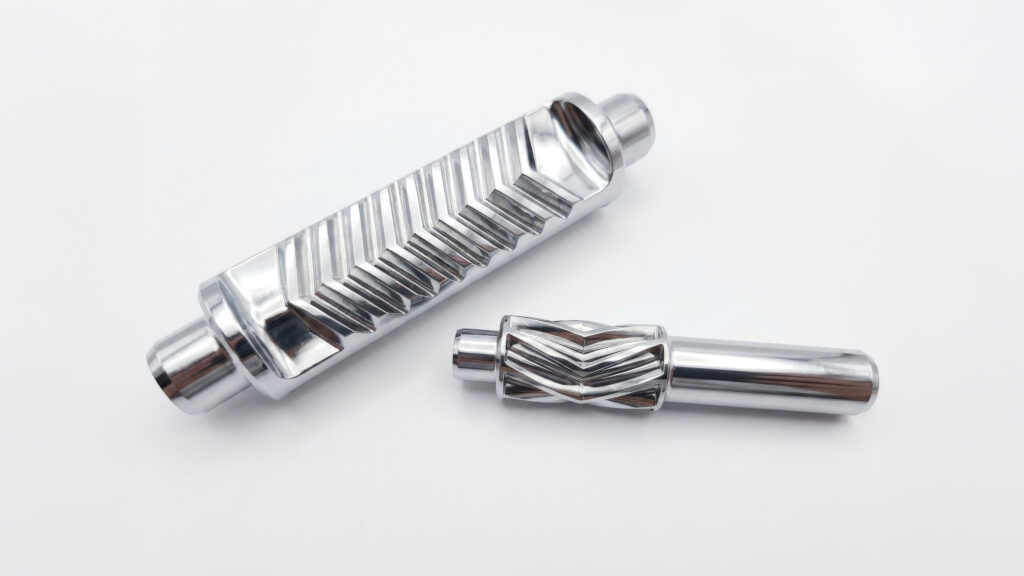
In a progressive steering rack, this condition is lifted. During the envelope process, the rack no longer follows a straight line — and therefore the local gear ratio varies continuously along the rack length. For every position along the rack, a different kinematic condition applies: the pinion must mesh without interference at every contact point, free of flank interference, inadmissible backlash, and without compromising tooth root load capacity. The geometric coupling between pinion and progressive rack is therefore no longer a standard involute pairing, but a continuously variable gear mesh problem that is no longer feasible in standard calculation tools.
The design methodology must therefore be implemented in a dedicated software environment. For every discrete position along the rack, the pressure angle, addendum and dedendum geometry, contact ratio, and resulting contact stress must be calculated separately — and assembled into a consistent overall geometry that is manufacturable. Even a slightly erroneous transition curve between two gear zones generates steering torque discontinuities in operation that the driver immediately detects and that are unacceptable under race conditions.
Humbel has developed a purpose-built algorithm for this problem class that delivers the complete geometry for a customer-specific variable steering rack — from specification to production-ready dataset — within two weeks. A key aspect of this methodology: every generated geometry is assessed from the outset against producibility criteria. In this process, the boundary between calculation output and manufacturing reality does not exist.
Titanium Machining for Motorsport: A Material That Accepts No Compromise
For a steering component in Formula 1, the material choice is largely predetermined: advanced titanium alloys — typically representatives of the α-β group such as Ti-6Al-4V or higher-performance variants like Ti6246 with elevated mechanical properties — provide the required strength-to-density ratio. The component must withstand extreme load cycles, at minimum weight, in a highly confined installation space.
Titanium gear machining belongs among the most demanding tasks in manufacturing technology. The thermal conductivity of titanium alloys lies at approximately 6–8 W/(m·K) for highly alloyed variants — far below that of steel. The vast majority of the process heat generated during machining therefore remains at the cutting edge — unlike steel, where a substantial proportion is carried away with the chip. The resulting thermal load on the cutting edge, under inadequately designed process parameters, generates chemical reactions between tool and workpiece as well as the built-up edge effect, which causes an abrupt deterioration in surface quality.
Particularly critical in this context are very small tool diameters, as required for forming the tooth flanks and root fillets of a motorsport-grade fine gear tooth form. Tool life for such tools is fundamentally limited when machining titanium; with variable engagement conditions along the rack, managing these tool lifespans becomes an independent manufacturing planning challenge. Tool change strategies, cutting parameter adjustments, and coolant concepts must be embedded in the NC programming such that no tool change boundary falls within a geometrically critical zone of the rack.
Surface Finish as a System Requirement for DLC Coating
The specified coating — a carbon-based layer, commonly applied in motorsport as a Diamond-Like Carbon (DLC) coating — tolerates no inadequately prepared substrate surfaces. DLC layers are typically applied at thicknesses of a few micrometres; they conform to the substrate surface without compensating for unevenness. A roughness profile that exceeds the specified values carries directly through into the coated surface and compromises run-in behaviour and fatigue strength of the pairing under tribological load.
For the tooth flanks of such a rack, this means: surface finish is not a quality afterthought, but a constructively defined system requirement that must be planned from the very first machining step. If needed, Isotropic Superfinishing (ISF) is applied for surface finishing excellence. The ISF process generates a near-directionless micro-topography of the surface through a chemomechanical interaction. This not only contributes to roughness reduction, but also improves adhesion of the subsequent DLC coating on gear components, since the isotropic surface enables more uniform coating bonding than a ground surface with a directional grinding structure.
Engineering and Manufacturing as an Inseparable Unit in Variable Gear Ratio Design
What fundamentally distinguishes this type of project from a conventional contract manufacturing assignment is the necessity of treating design and manufacturing not as sequential steps, but as an integrated problem. An externally developed geometry, designed without manufacturing knowledge, regularly reaches its limits in titanium machining: tooth root radii too tight to be achieved with available tool diameters, transition curves that cannot be correctly formed under process conditions, or tolerance requirements that cannot be maintained within the intended manufacturing sequence.
For this variable gear ratio rack design project, Humbel covers the complete development and manufacturing chain from a single source: from the design algorithm through prototype manufacturing and validation to production readiness. This is not an organisational convenience — it is a technical necessity at this level of complexity. Those who know the geometry also know its limits in machining — and those who command both sides can realise a development cycle that counts in the Formula 1 environment: short, precise, and reproducible.
If you are developing a similar variable steering rack or precision gear component for a high-performance application — whether in motorsport, aerospace, or industrial drive systems — we invite you to discuss the geometric requirements directly with Humbel’s engineers.