

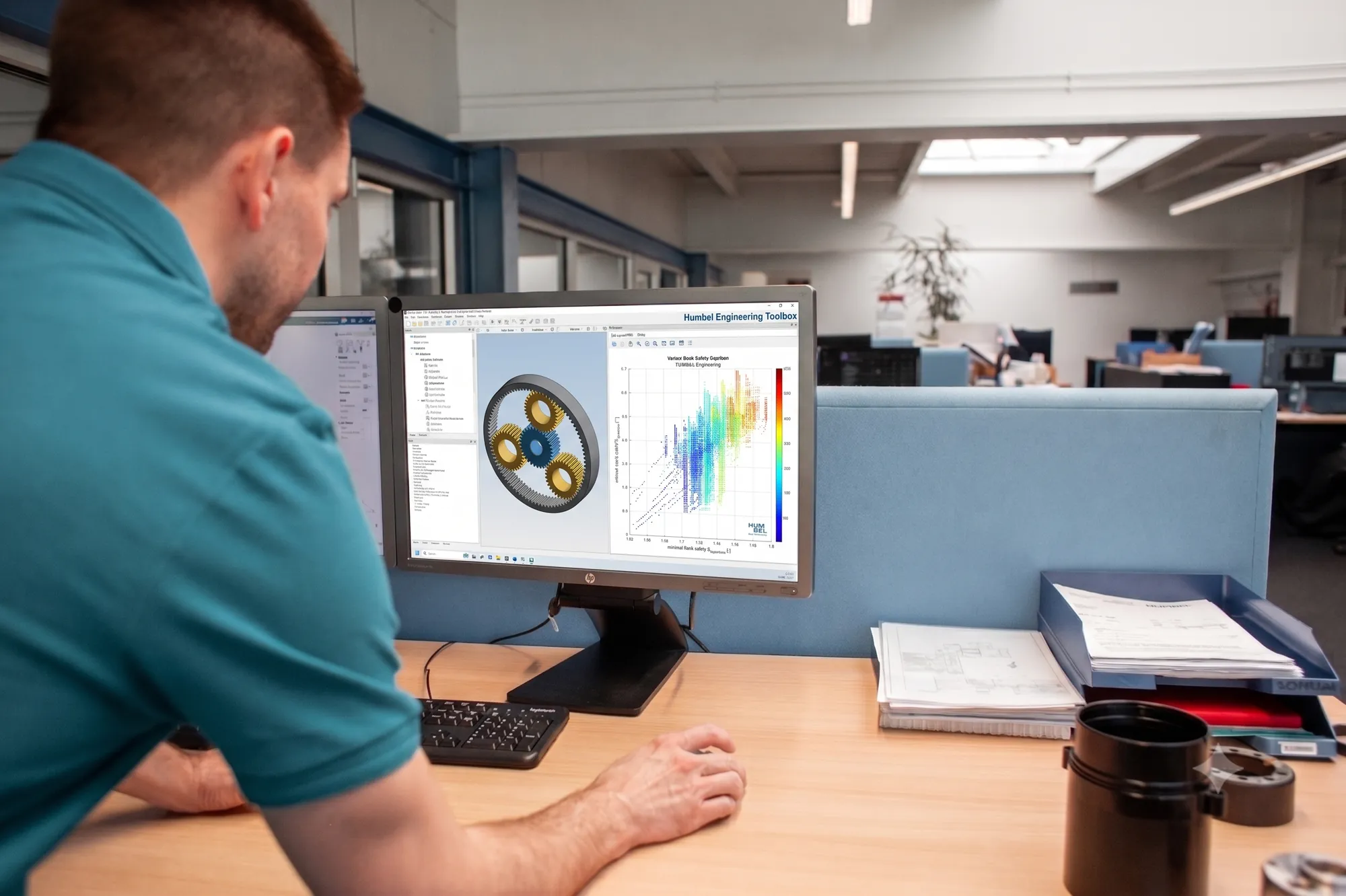
Gearbox optimisation with the Humbel Engineering Toolbox: The best solution for your drive application
When standard approaches reach their limits, a structured variant analysis — which considers the entire system, from gear geometry to housing stiffness — identifies the optimal solution for your gearbox design.
At a Glance
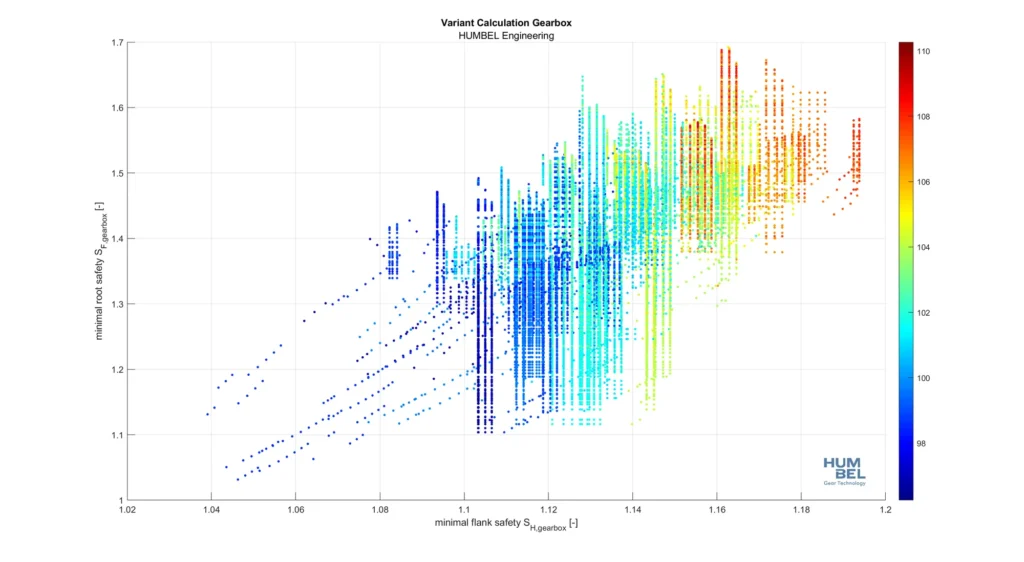
- The Humbel Engineering Toolbox uses a modular, constraint-based variant analysis to evaluate a large number of tooth geometry combinations (>10⁹) against your specific boundary conditions, while taking into account factors such as shafts, bearings, gear body geometry and housing stiffness.
- From low-noise chassis transmissions to power-density-optimised motorsport transmissions and stepped planetary gearboxes, the Toolbox supports transmission optimisation across all industries.
- The scope of services is scalable, from complete transmission system optimisation to targeted analysis of individual sub-problems, depending on your project’s requirements.
The challenge: Gear system optimisation is a multidimensional engineering problem
Gearbox design is one of the most demanding tasks in mechanical engineering. While a gear may appear to be a simple component at first glance, it conceals a highly complex system of interacting physical phenomena.
Gearbox optimisation requires simultaneous consideration of numerous, often conflicting requirements: efficiency, load capacity, service life, noise emission, weight, and cost compete directly with one another. Any change to one parameter automatically affects several others — a classic multidimensional optimisation problem.
The conventional approach of iterative trial and error by an experienced engineer works well for simple cases. However, this method has its limitations when the number of influencing factors increases, when boundary conditions are strict and interdependent, or when the solution space contains non-obvious optima that only become apparent through a holistic system evaluation.
In practice, this means that many gear designs are not poorly designed; they simply have not been studied enough. The best solution may exist within the permissible solution space, but it was never found because the search was not systematic enough.
The Humbel Engineering Toolbox: Structured Gearbox Optimisation Across the Entire System
Modular, Constraint-Based Variant Analysis
The Humbel Engineering Toolbox is based on a modular design principle for gear optimisation. Rather than optimising a single parameter in isolation, the tool evaluates a large number of geometric variants, such as number of teeth, modules, profile shifts, helix angles and tooth widths, against a defined set of constraints and target specifications.
The key feature of this approach is that it can handle exponentially growing variant spaces without sacrificing completeness. As the number of variables increases, manual iteration becomes unmanageable. The toolbox is designed to systematically search through this complexity and ensure that the best available solution is identified under the defined constraints — not merely a satisfactory one.
This is not a standard calculation method. It is individually tailored and configured for each project, with constraints and weightings that reflect your specific requirements.
Beyond the gear pair: System optimisation for the entire drive design
An individually optimised tooth profile can perform poorly in a real system when shaft stiffness, bearing stiffness, and housing stiffness affect contact pattern and system vibration behaviour.
That is why the Humbel Toolbox does not limit its scope to gear geometry alone. Shaft and bearing dimensioning, gear body geometry, and housing stiffness are fully integrated into the calculation. The result is an optimisation that reflects a highly realistic operating environment — not an idealised abstraction.
Contact pattern behaviour under load, transmission error, and load distribution across face width are outputs of the complete system model — not subsequent verification steps.
Scalable scope of functionality: From overall system optimisation to specific sub-problems
Not every project requires overall system optimisation. The toolbox can also be applied to specific sub-problems, such as optimising profile corrections on a specific gear pair to reduce mesh impact, determining the optimal helix angles for a stepped planetary gear, or evaluating whether a specific gear can be used across multiple gear stages without compromising load-carrying capacity or service life.
Limiting the scope of services to what is actually needed keeps the process efficient and economically viable.
Application examples: Gearbox optimisation across industries
Noise optimisation of chassis drives: Optimising transmission error across the entire load range
Chassis drives operate within defined speed ranges and load spectra. Gear mesh noise is a central acceptance criterion for many of these applications. The cause of noise excitation is transmission error — the deviation of the driven gear from uniform rotational motion, caused by tooth stiffness fluctuations and geometric deviations in the mesh.
Reducing transmission error requires careful optimisation of profile modifications (tip and root relief), helix angle, and contact ratio. The challenge is that the optimal modification depends on the operating load condition — what works at full load can worsen NVH behaviour at partial load. The Humbel Toolbox evaluates these trade-offs across the relevant load range and identifies modification strategies that deliver consistently low transmission error under the actual operating conditions of the drive.
Maximum power density for motorsport and high-performance transmission applications
Motorsport gearboxes define the technical extreme. Installation space is fixed, weight targets are non-negotiable, and load spectra are characterised by highly stressed shift and torque events. The goal: maximum load capacity from minimum volume and weight.
This requires simultaneous optimisation of gear geometry, shaft and bearing calculations, material and heat treatment selection. Humbel’s motorsport experience — gained through developing gears in racing — provides deep understanding of the engineering principles behind extreme power density and their transferability. The Toolbox translates this knowledge into a systematic, reproducible optimisation process for high-performance applications such as electric vehicle drivetrains or aerospace gearboxes.
Stepped Planetary Gearbox Design: High Ratios with Systematic Constraint Fulfilment
Stepped planetary gearboxes represent a special configuration of the classic planetary gear. Unlike simple planetary gears, the planet gears feature two rigidly connected gear meshes with different modules and tooth counts. This design enables higher gear ratios, achieving high power density in a compact design.
The design of stepped planetary gearboxes is considerably more complex than simple planetary gears. The key challenges include load distribution across multiple stages, consideration of deformations under load, coordination of number of teeth and modules, and coupling effects between components. Due to the numerous interactions in the system, early consideration of deformation behaviour and vibration excitation is critical for successful gearbox development. Our Toolbox covers all aspects and finds the optimal solution for your application.
Multiple Gear Stages with Shared Gears: Coupled optimisation for complex drive architectures
When a drive architecture requires multiple gear stages and a shared gear is used as a common element across multiple stages, the optimisation problem becomes coupled. The number of teeth and the geometry of the shared gear must simultaneously meet the requirements of all the involved stages — gear ratios, load-carrying capacity and assembly feasibility. This interplay of many conditions makes manual iteration time-consuming, and it is easy for better solutions to go undetected. The Humbel Toolbox addresses this type of system optimisation in a structured manner.
Design for Manufacturing (DfM): From Optimised Gear Design to Manufacturable Component
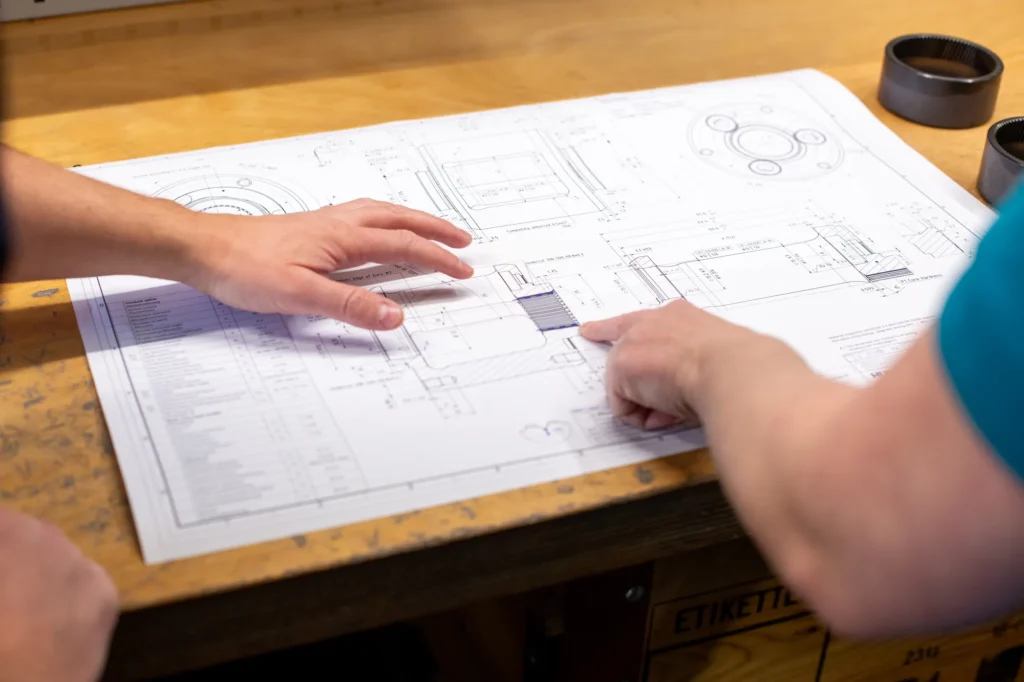
Humbel is a contract manufacturer. This means the engineering team responsible for optimisation works in close collaboration with the production facility. Every design resulting from the Toolbox is evaluated for manufacturability from the outset.
In practice, this means: gear geometries that are theoretically optimal but require process steps incompatible with stable, reproducible manufacturing are identified and adjusted before they become problems in production. Tolerances are defined based on functional requirements and manufacturing competence — not uniformly independent of the manufacturing process.
This DfM integration is not a downstream verification step. It is embedded in the optimisation process. For customers, this concretely means: fewer iterations between design and manufacturing, lower risk of subsequent design changes, and greater confidence that first article inspection results reflect the intended geometry.
The connection between engineering optimisation and manufacturing also means that Humbel’s cross-industry experience — from railway drives to motorsport gearboxes to aerospace transmissions — flows back into the Toolbox.