

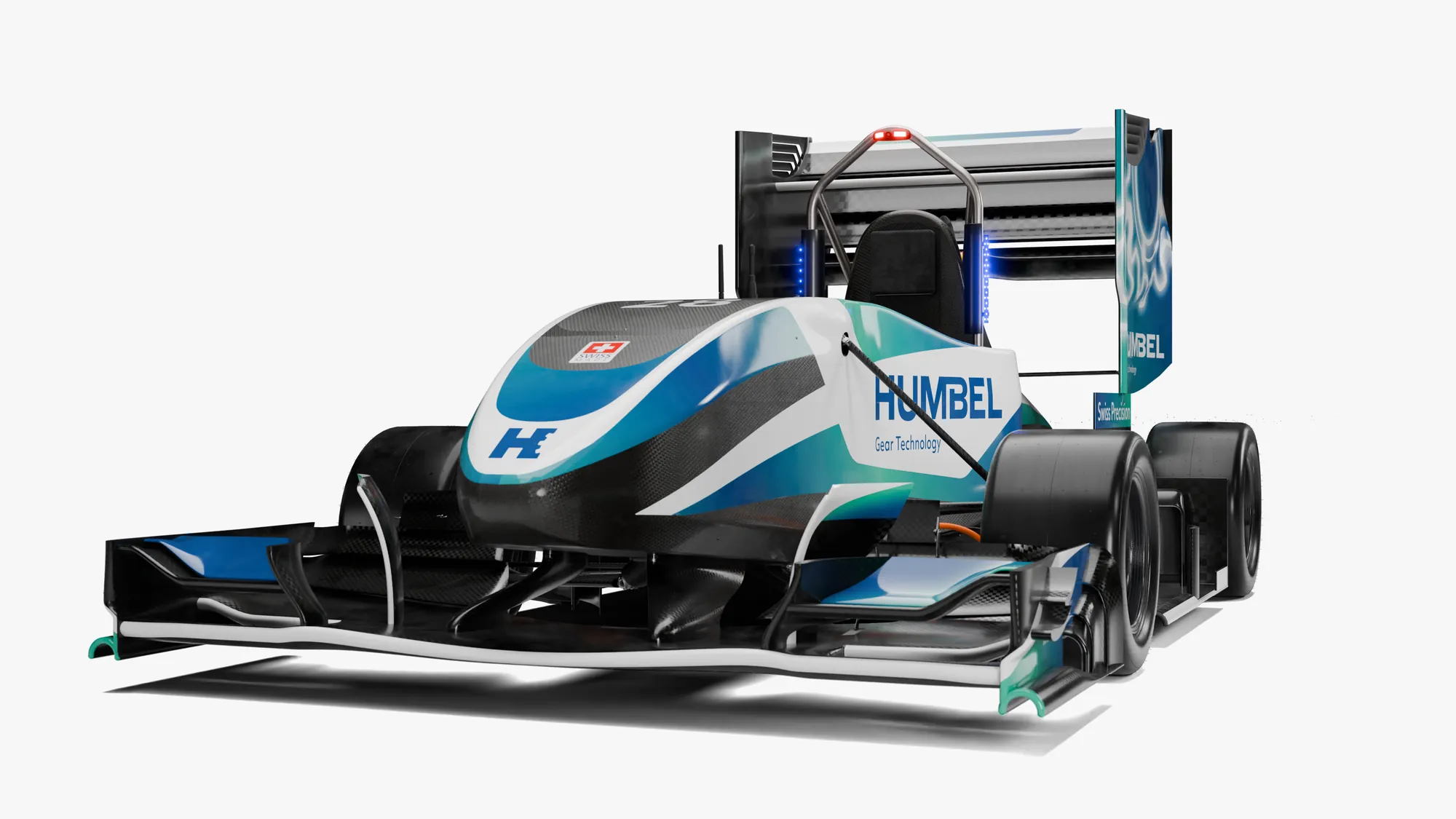
When students design, build, and race a complete formula car within a single year, it is about more than engineering knowledge.
It is about passion, ambition — and decisions made under real pressure.
That is why Humbel is actively involved in Formula Student.
Many of the engineers at Humbel have gone through exactly this process themselves. Today, we manufacture a precision-engineered planetary gearbox for Formula Student electric vehicles — designed for competition use and available to teams worldwide.
Quick Summary
- Formula Student (also known as Formula SAE) is the world’s largest engineering design competition for students. Each year, more than 500 teams develop race cars under real technical and organisational constraints — with an increasing focus on complex electric drivetrains.
- Developing compact, high-load gearboxes poses fundamental challenges for many teams: gear design, material selection, and precision manufacturing — combined with limited access to manufacturers willing to produce small-batch motorsport-grade components.
- Humbel has developed a planetary gear set specifically engineered for Formula Student electric vehicles. The gear set is supplied as a complete, ready-to-install package and is available to teams worldwide.
- The foundation is a combination of decades of precision manufacturing experience in motorsport and aerospace, and an engineering team with direct Formula Student backgrounds.
What Is Formula Student? The World’s Leading Engineering Design Competition
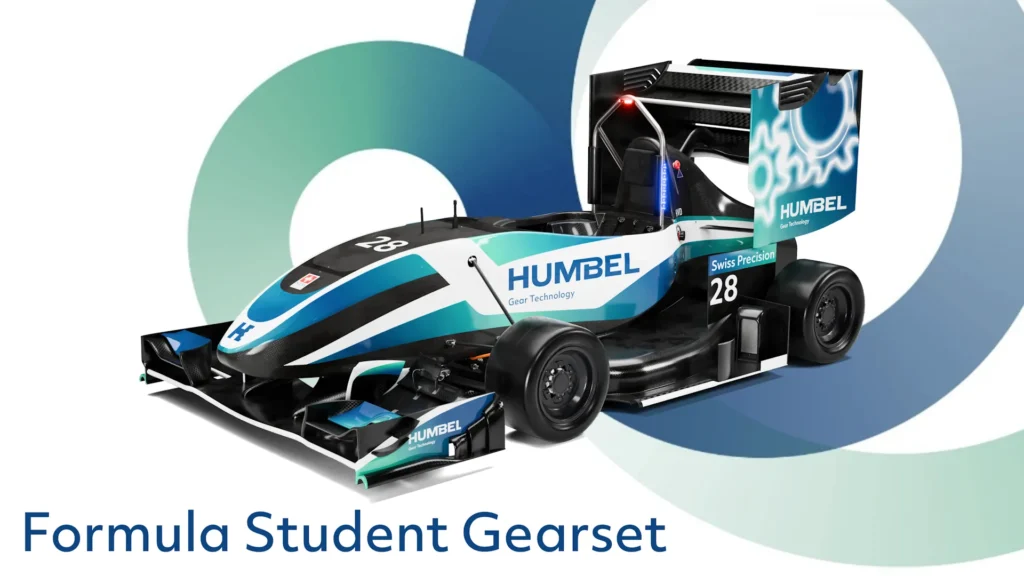
Formula Student (FS) — known as Formula SAE in North America — is an international engineering competition in which student teams from universities worldwide conceive, design, manufacture, and race an open-wheel formula car. Originally founded in 1979 by the Society of Automotive Engineers (SAE), the competition today spans events on racetracks around the world. Formula Student Germany at the Hockenheimring is among the most prestigious.
The competition deliberately extends far beyond raw vehicle performance. Teams are evaluated not only on lap times but also in static disciplines such as Engineering Design, Cost Analysis, and Business Case Presentation. Dynamic events — Acceleration, Skidpad, Autocross, and Endurance — test whether the vehicle functions reliably under real conditions.
This combination is at the heart of what makes Formula Student unique.
Students take full responsibility for a complete vehicle: from the first concept decision to competition on the track. Design, procurement, manufacturing, testing, and operation run in parallel — within one year, with a limited budget and under significant time pressure.
What appears from the outside to be a student project is internally often a high-intensity development process. Many decisions are not made by the textbook but under real constraints — and they still need to work. The ongoing shift toward electric drivetrains has further increased technical complexity in recent years. Compact, wheel-integrated drive concepts place high demands on packaging, weight, and component reliability.
This is precisely where the challenge becomes very specific — and for many teams, the limiting factor.
The Core Challenge: The Gap Between Gearbox Design and Precision Manufacturing
Designing a planetary gear set for a Formula Student electric vehicle is not a standard undergraduate exercise.
It requires a thorough understanding of the interaction between geometry, loads, materials science, and manufacturing processes — under constraints that are tightly defined by the competition.
Many teams deliberately take on this development themselves. Thoughtful concepts, detailed CAD models, and viable solutions emerge. At the same time, practice consistently reveals a second dimension: what makes sense in a design is not automatically feasible in manufacturing — at least not under the given constraints of time, budget, and batch size.
Over the years, Humbel has been contacted repeatedly by teams who reach exactly this point. The concepts are in place, the motivation is high — but the path to realisation raises new questions:
How can components be manufactured economically in small quantities? What tolerances are realistically achievable? What process steps are needed to reach the required service life?
This becomes especially clear when it comes to manufacturing access.
A complete planetary gear set consists of multiple high-precision components — sun gear, ring gear, stepped planet gears, bolts, and ancillary parts — that typically require hardening and grinding. For most contract manufacturers, the required batch sizes of a few sets are not economically viable. At the same time, standard delivery timelines are often incompatible with the tight schedule of a Formula Student project.
For teams, this means:
A concept that works on paper gets stalled in execution. Development time shifts into sourcing and coordination — or compromises are made that later affect weight, efficiency, or reliability.
Humbel’s Solution: A Ready-to-Install Planetary Gear Set for Formula Student Electric Vehicles
Humbel has manufactured precision gearboxes for decades in applications where packaging, weight, and reliability must be optimised simultaneously — in motorsport as well as in aerospace.
The requirements are comparable: high power density, tight tolerances, and zero in-service failures.
Against this background, the decision was made to develop a dedicated planetary gear set for Formula Student.
Not as a generic standard product, but as a targeted answer to a recurring question:
How can a compact, high-load gear set be reliably realised under realistic constraints — and made accessible to teams?
The development is based on direct feedback from the Formula Student community as well as internal expertise in design and manufacturing. The goal was to create a solution that is technically robust while reducing the integration effort for teams.
The result is a planetary gear set specifically engineered for electric Formula Student vehicles, delivered as a complete, ready-to-install system.
Technical Specifications: Formula Student Planetary Gear Set
The Humbel planetary gear set is designed for use in electric Formula Student vehicles with 10-inch wheels. The focus is on a compact design, low weight, and reproducible load capacity under competition conditions.
Key Data:
| Parameter | Value |
|---|---|
| Gear ratio | 12.481:1 (output on ring gear, fixed planet carrier) |
| Maximum input torque | 32 Nm |
| Design service life | ≥ 1,000 km under average seasonal load |
| System weight | < 0.5 kg per gear set |
| Motor compatibility | AMK, DTI, Fischer, and custom electric motors |
| Sun gear shaft interface | External spline or internal spline (two variants) |
| AWD vehicle package | 4 gear sets, < €10,000 total |
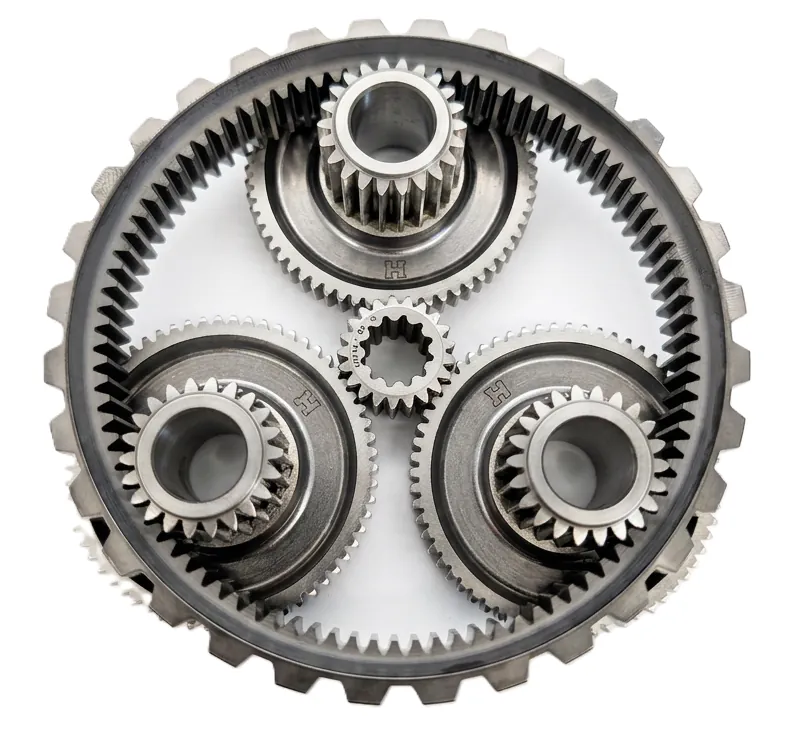
The gear set is supplied as a complete, ready-to-install system. Included are stepped planet gears, sun and ring gears, planet bolts, and all required ancillary components.
CAD data, technical drawings, and bearing recommendations are part of the delivery scope and support integration into the wheel assembly. Particular attention has been paid to the interfaces: adjacent structural components such as uprights or motor flanges are deliberately designed so that they can be realised using standard manufacturing processes.
The gear teeth are manufactured from high-purity steels as used in aerospace applications. The tooth flanks are hardened and ground, with targeted profile modifications to improve the contact pattern and running behaviour. This design accounts for the typical load cycles and operating conditions in Formula Student competition and ensures reproducible function throughout the service life.
Sun Gear Shaft Variants: External and Internal Spline for AMK, DTI, and Fischer Motors
The interface between the electric motor and the gearbox is not standardised across the Formula Student field. Different motors use different shaft geometries and spline profiles.
To enable direct integration, the Humbel planetary gear set is offered in two variants: with an internal spline and with an external spline at the sun gear shaft.
Teams can select the appropriate variant based on their motor choice and connect the gearbox without additional adapter solutions. This eliminates extra components that would otherwise increase packaging volume, weight, and potential failure points.
Why Humbel Is Committed to Formula Student
A significant part of the engineering team at Humbel comes from Formula Student.
Many of today’s engineers have themselves developed vehicles, made decisions under time pressure, and experienced the typical challenges of an FS project.
This background shapes the way the company works.
Technical questions are not looked at in isolation, but always in the context of manufacturing, integration, and real-world use. Decisions are challenged early — not only once a component has already been manufactured. And the focus is on developing solutions that actually work under the given constraints.
This same understanding flows directly into the development of the Formula Student gearbox.
When a team comes to us with a specific question — whether on gear design, integration, or manufacturing details — the exchange happens at eye level. Not from a pure supplier perspective, but from first-hand experience in the same environment.
Humbel’s involvement in Formula Student is therefore not an isolated project, but part of a wider context. The education and development of young engineers does not happen only in lecture halls, but in exactly these kinds of projects.
Many of those currently working on FS vehicles will later be active in the development of drivetrain systems in motorsport, the automotive industry, or aerospace. The way they make technical decisions will lastingly shape the quality of these systems.
For Humbel, Formula Student is therefore also an investment in the future of the engineering discipline — and in the people who will advance it.
Continuous Development in Collaboration with Electric Motor Manufacturers
The current design of the planetary gear set is not intended to be static. Humbel maintains close collaboration with electric motor manufacturers to continuously develop the system.
The focus areas are gear ratio, interface geometries, and alignment with real-world load spectra. Feedback from competition use and experience from previous seasons feed directly into the development process.
This iterative approach reflects standard practice in motorsport: solutions are deployed under real conditions, evaluated, and continuously improved. Input from Formula Student teams themselves is an important element in keeping the system grounded in practical requirements.
What This Means for Formula Student Teams in Practice
The decision to use an existing gearbox solution rather than developing one in-house is not a shortcut — it is a deliberate reallocation of development resources.
Instead of investing time in the design, iteration, and procurement of a custom gearbox, teams can direct their resources towards other areas — such as vehicle dynamics, aerodynamics, or control systems.
The gear set provides a defined starting point: known interfaces, transparent performance data, and a system designed for competition conditions. This reduces uncertainty in the integration process and minimises procurement risks.
At the same time, the decision remains deliberately open. Teams who wish to develop their own gearbox concepts can continue to do so. In this case, Humbel is also available for technical exchange — for example on manufacturing questions, material selection, or gear design.
Contact and Further Information
Teams working on the integration of an electric drivetrain, or with questions about the planetary gear set, are welcome to contact us directly.
The focus is on dialogue — regardless of whether it concerns a concrete implementation with the Humbel gear set or general technical questions. In our experience, many questions arise only in the detail of integration, and an early exchange can help avoid unnecessary iterations.
Interested teams can reach us at any time. Enquiries are answered promptly, and technical questions can generally be discussed directly with the engineering team.
Further information, technical data, and CAD models are available online: 🔗 humbel-gears.com/en/products/planetary-gearbox
📧 Contact: fs-gearbox@humbel-gears.com